
Editorial Director Vaihayasi Pande Daniel creates digital content/writes on travel, food, lifestyle and more for 30 years. You can e-mail the author at haysidaniel@rediffmail.com

After the wedding, Sheena and Mekhail did not meet again. Four or five months later she met her death. Mekhail referred to their last meeting without overt emotion, clear-eyed.
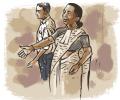
Ever since Mekhail had first entered the courtroom, he had, it would seem, never once looked at his mother, though they were a few metres away from each other. Curiosity, residual regard, memories, anger, none of it, could make him even look at the woman who gave birth to him. Was his hatred so overpowering?

One couldn't help feeling a certain melancholy viewing these now vagrant documents and photographs that would never be rightfully cherished. The pictures spoke to you. They offered slices of extinguished lives. They breathed sadness too, for what could have been and will never be. The sweet promises that Life made and insolently, arrogantly never kept.

The ripping off the lid, that Mekhail did, on the chain of episodes that lead up to his sister's murder, while condemning Indrani for her actions, for the first time, paradoxically, allowed a more human -- if flawed and complicated -- picture to emerge of Indrani, allegedly The Woman Who Killed Her Own Daughter and shocked a nation.

Throughout, Mekhail spoke calmly, with hardly an inflection making even the barest attempt to hijack his tone. His tone was so empty it made his narrative all the more touching. And ugly and grey, as the monsoon sky beyond the window.

'It is vital that objects such as the Harihara -- and collections from South Asia generally -- remain here,' the British Museum tells Vaihayasi Pande Daniel.

'Does a thousand-year-old sculpture worshipped in a thriving religion belong to a foreign museum or the temple from which it was extracted?' Congress MP Shashi Tharoor asked angrily. 'They legitimately belonged to India and people of past, present and future generations are interested in re-possessing them,' a central information commissioner declared last month.

Shashi Tharoor says the British Museum should change its name to Chor Bazaar because whatever it has within its portals is the result of 200 years of theft. The museum is once again in the eye of a storm for the possession of a statue of a god Hindus, across the world, worship as the Supreme Being.

One always ponders over why the witnesses should not have poor memory when answering cross examination questions or recounting events that occurred six years ago. Too many witnesses seemed to have drunk some Harry Potter-esque Philosopher's Stone magic elixir that has Botoxed their fading memory to make it as good as new again.

After ten minutes no one could keep track of the legal team's questions on the geography of the route Sandeep Patil took on his Pulsar Bajaj motorcycle, on the morning of April 25, 2012. Not the judge. Or the onlookers. Least of all Patil.

Something about the big car and its passengers, standing solemnly outside their vehicle, piqued the biker's interest.

That answer, the strangest of all till date in this courtroom, set off a ripple of excitement, surprise and muted amusement among those present, including Accused No 1 Indrani Mukerjea.

Though on the face of it appeared Pasbola was asking a series of odd questions that would be difficult for anyone to answer, there was, it gradually emerged, it seemed, a method to the questioning. Somehow, somewhere instinctively, Pasbola knew there was something not right with Riyaz's account.

Indrani chose at that moment to wave a folded chit from the accused enclosure. It distracted Bharti, who looked at her sharply for a split second before turning back to Pasbola. The chit was collected from Indrani and her lawyer Gunjan Mangla slipped it to Pasbola. He looked at it, quietly laughed in disbelief and continued with his cross examination.

Clusters of policemen and television journalists alertly anticipated the arrival of Mumbai's joint commissioner of police, who, it was confirmed by most people I asked, does not visit court often. No one could remember when they had last heard of Deven Bharti appearing as a witness in a murder trial.

How much more gray or bald would Inspector Alaknure have become when we see him next? Will Peter still be wearing white shirts and khaki trousers and eating large lunches? Will Judge Jagdale be still in charge of the case? Who will be the prime minister when Alaknure appears in court next?

Shyamvar Pinturam Rai and Pradeep Waghmare. Both erstwhile employees of Peter and Indrani Mukerjea. In the witness stand on Monday, Waghmare came across as a cheerful, straightforward man who is attempting to clamber his way towards prosperity. In the witness stand on Friday, Rai shed his customary jauntiness and broke down weeping, begging forgiveness from CBI Special Judge Jayendra Chandrasen Jagdale.

The lesson Waghmare sternly received on Monday from CBI Investigating Officer K K Singh and CBI Prosecutor Bharat Badami about the way a witness must answer questions from the defence seemed to have had only a marginal effect on him. On Tuesday the timid former office boy still chose, unpredictably and remarkably, to answer many a question in the manner of his choosing. He told the room categorically that he had asked Indrani's former secretary Kajal Sharma not to forge Sheena Bora's signature on her resignation letter.

Singh and Badami subsequently took Waghmare to a corner of the corridor outside, where others have no access, and gave him a lecture. The conversation was largely inaudible, except for a phrase here or there. The thrust was unmistakable. Waghmare had to learn not to give such detailed answers to the defence.

'In any business you have to achieve short-term goals.' 'But at the same time you have to keep your broader perspective long term.' 'It is good for business survival.'
